Head of Household vs Single: 2026 Tax Filing Guide
Quick Answer: You may qualify for Head of Household if you are unmarried or considered unmarried, paid more than half the cost of keeping up your home, and have a qualifying person under IRS rules. Special rules can apply to parents, divorced or separated taxpayers, and certain other situations.
“Head of Household vs Single”: What’s the Difference?
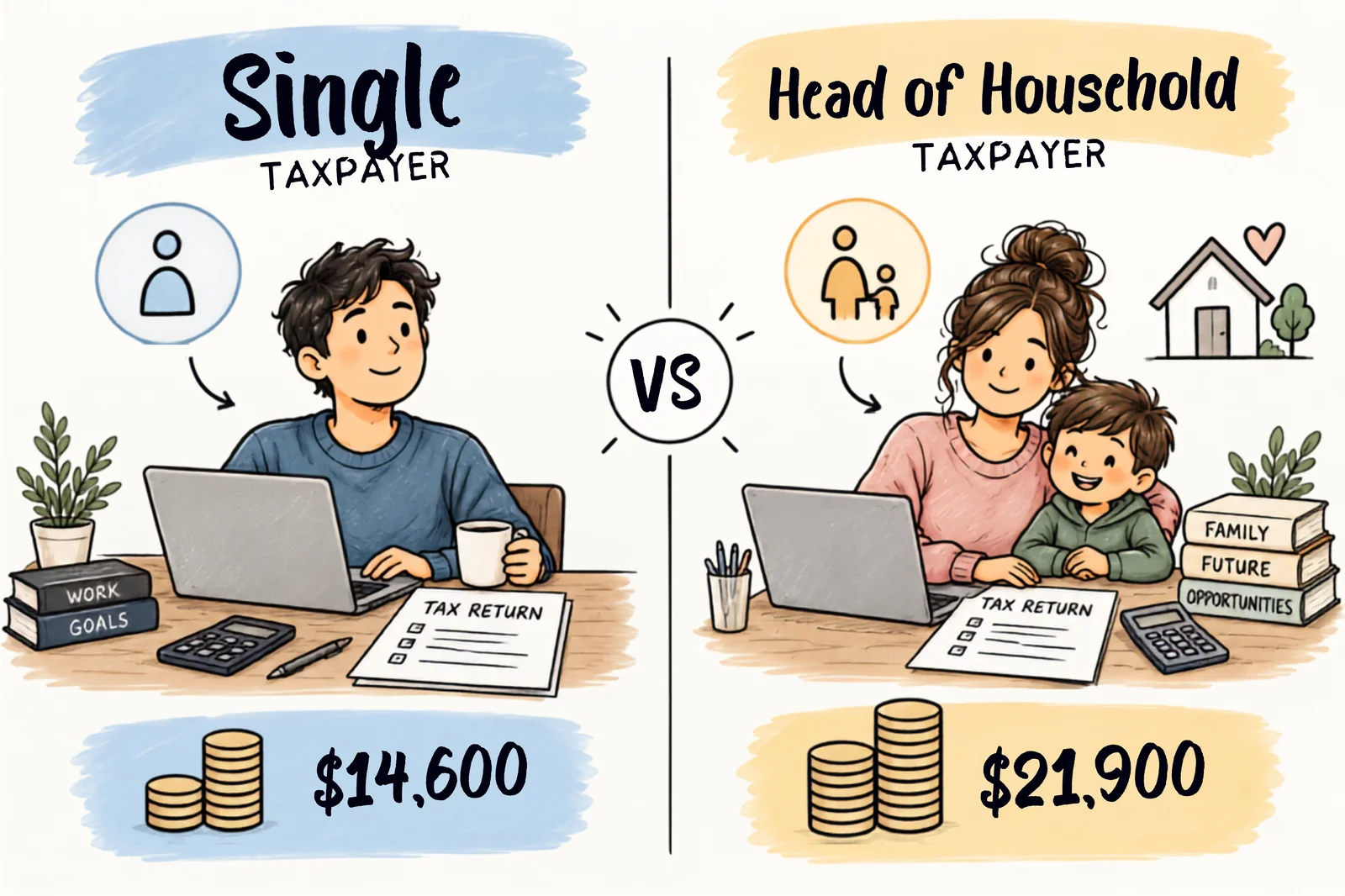
The simplest distinction is this:
- Single is generally available to taxpayers who are unmarried, divorced, or legally separated and who do not qualify for another filing status.
- Head of Household is a different filing status with additional requirements. In general, you must be unmarried or considered unmarried, pay more than half the cost of keeping up your home, and have a qualifying person under IRS rules.
That means having a child does not automatically make you Head of Household. Likewise, living alone does not automatically mean you must file Single.
The real question is: Do your marital status, household costs, and qualifying person situation satisfy the IRS rules? That’s what this guide helps you determine.
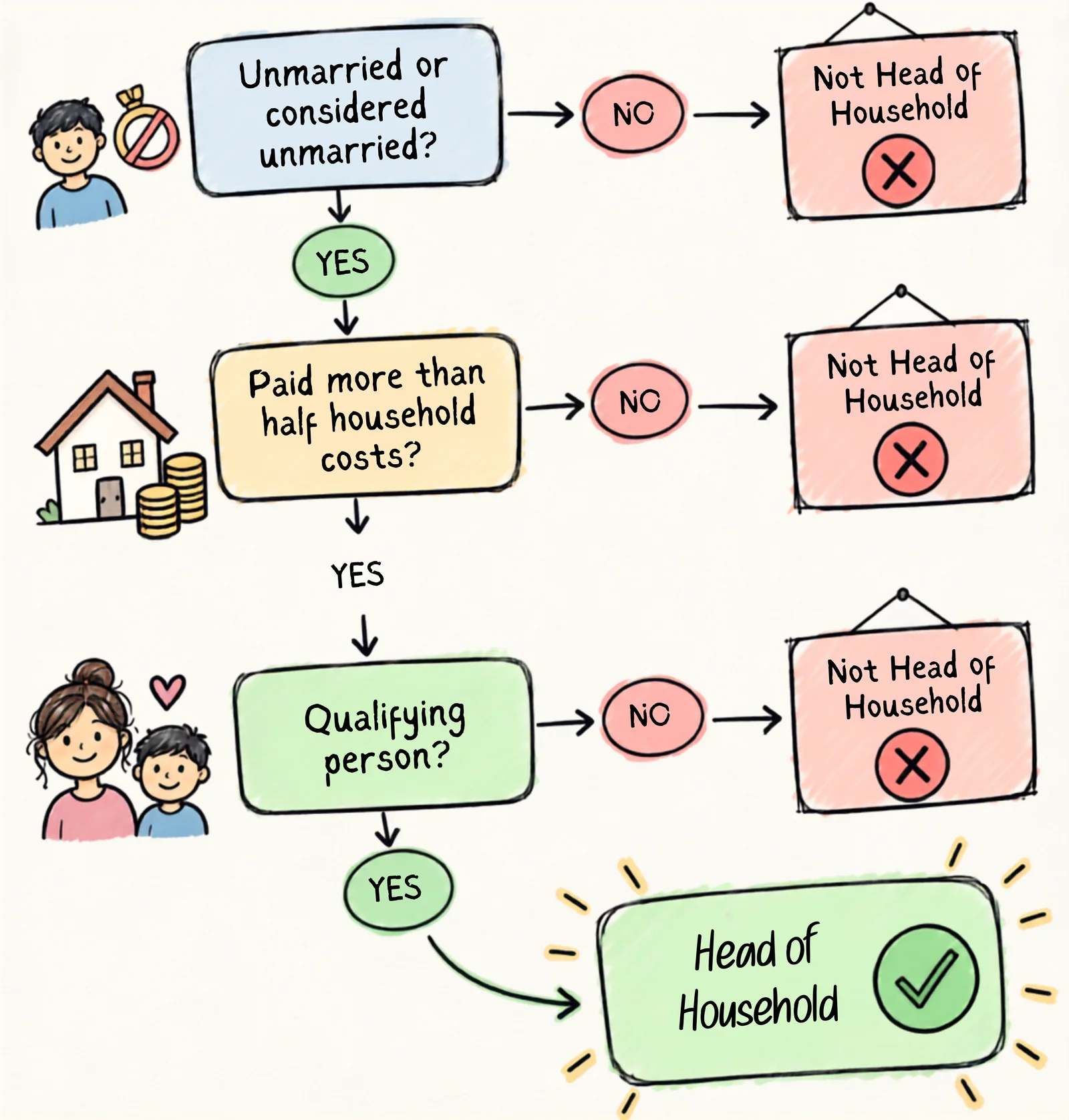
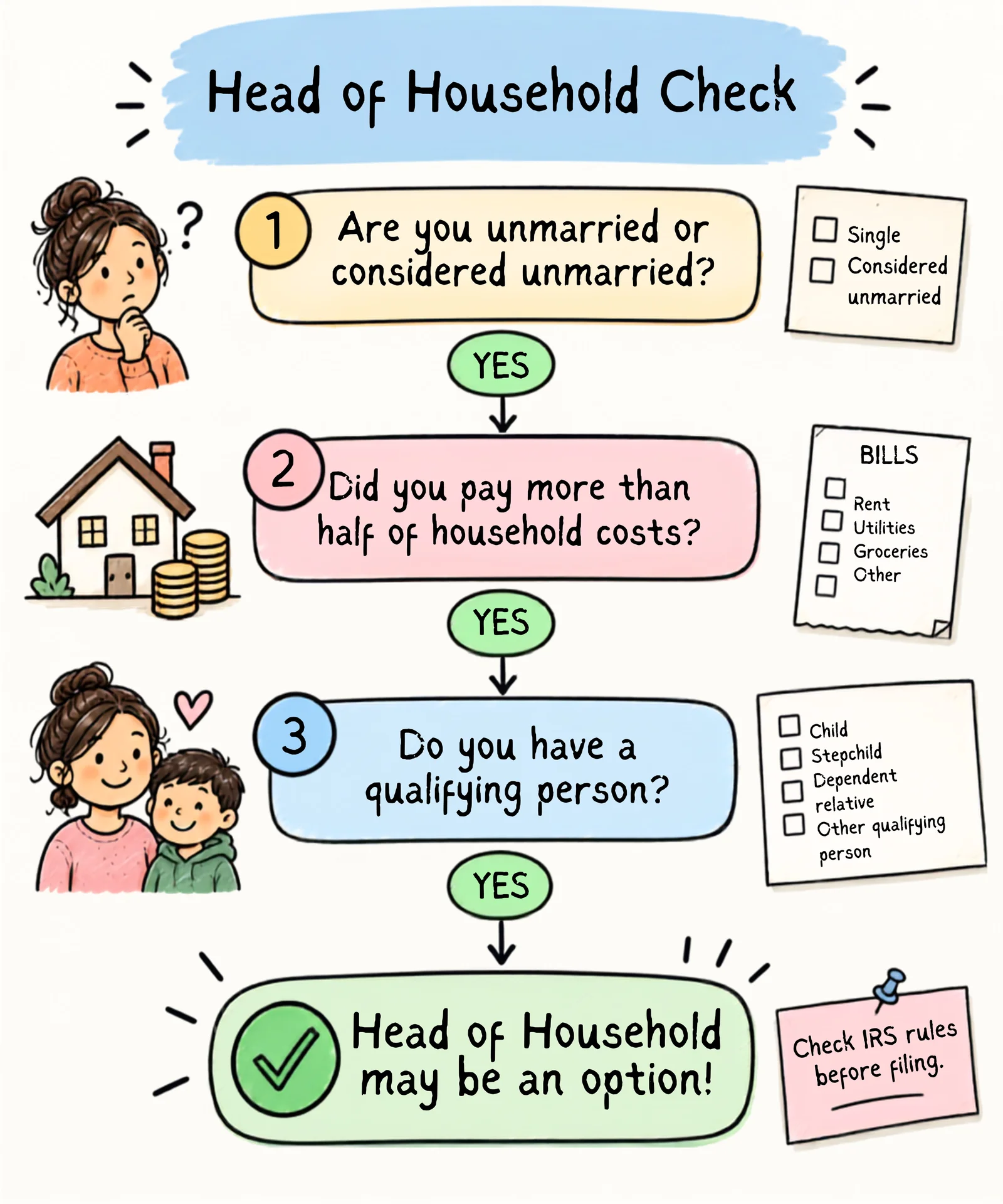
The 30 Second Head of Household Test
Before getting into the details, use this quick screening test:
- Were you unmarried or considered unmarried at the end of the tax year? If yes, continue. If you were married, special rules may allow Head of Household in some circumstances, but simply living apart from your spouse for part of the year isn’t automatically enough.
- Did you pay more than half the cost of keeping up your home? This generally includes qualifying household costs such as rent, mortgage interest, property taxes, insurance, utilities, repairs and food eaten in the home.
- Do you have a qualifying person? A qualifying child or certain qualifying relatives can satisfy this requirement. A dependent parent has a special rule that can allow the parent to qualify even if the parent does not live with you.
If you pass all three core tests, Head of Household may be available to you. If you fail one of the required tests, you generally cannot simply choose Head of Household because it produces a lower tax bill.
What Is “Head of Household”?
Head of Household is a federal tax filing status for eligible taxpayers who maintain a home for themselves and a qualifying person.
The IRS filing status guidelines state that the general requirements include:
- being unmarried or considered unmarried at the end of the year;
- paying more than half the cost of keeping up the home; and
- having a qualifying person who meets the applicable IRS rules.
The filing status can matter because it can provide a higher standard deduction and different tax brackets than Single or Married Filing Separately. For 2026, the federal standard deductions according to IRS Tax Rates and Brackets are:
- Single: $16,100 standard deduction
- Head of Household: $24,150 standard deduction
- Married Filing Jointly: $32,200 standard deduction
These are federal figures for the 2026 tax year. State income-tax rules can differ.
“Head of Household” Requirements Explained
Requirement 1: You Must Be Unmarried or Considered Unmarried
If you were unmarried, divorced or legally separated under the applicable rules, you may meet this part of the test. Married taxpayers can sometimes qualify as “considered unmarried,” but the rules are specific under IRS Publication 501.
For example, the IRS generally requires that your spouse did not live in your home during the last six months of the tax year, along with other requirements involving your return, household costs and qualifying child. So: Living separately from your spouse for a few months is not automatically enough to qualify.
Requirement 2: You Paid More Than Half the Cost of Keeping Up Your Home
This is where many people make mistakes. The IRS includes costs such as:
- Rent and mortgage interest
- Real estate taxes and home insurance
- Utilities, repairs and maintenance
- Food eaten in the home and certain other household expenses
Some costs do not count toward the household maintenance calculation, including clothing, education, medical treatment, vacations, life insurance and transportation. The test is about the cost of maintaining the home, not simply whether you personally paid most of a child’s expenses.
Requirement 3: You Need a Qualifying Person
A qualifying child can potentially satisfy the requirement if the applicable IRS tests are met. Certain qualifying relatives can also matter. A particularly important exception involves a parent.
Can I File “Head of Household” If My Parent Doesn’t Live With Me?
Possibly, yes. The IRS has a special rule for a qualifying parent.
You may qualify even when your parent does not live with you if you can claim your parent as a dependent and meet the applicable household cost requirements. The IRS specifically notes that maintaining your parent’s main home can count, including certain costs of keeping the parent in a rest home or home for the elderly.
This is one reason you should not assume: “I don’t have a child, so I can’t file Head of Household.” The qualifying-person rules are more specific than that.
Can I File “Head of Household” If My Ex Claims My Child?
In some circumstances, yes. This is one of the most important situations for divorced or separated parents.
According to IRS rules on filing taxes after divorce or separation, a custodial parent may still qualify for Head of Household even when the noncustodial parent is entitled to claim the child as a dependent, provided the relevant requirements are met. These include being unmarried or considered unmarried, paying more than half the cost of keeping up the home, and having the child qualify under the applicable rules for this filing status.
So don’t use this shortcut: “My ex claimed the child, therefore I cannot file Head of Household.” The actual IRS rules need to be checked.
Can Both Parents File Head of Household?
Generally, not for the same child in the same household situation.
The IRS specifically addresses situations in which unmarried parents live together with their child. Only one parent may claim the child as a qualifying child for Head of Household purposes, subject to the applicable rules and tiebreaker provisions.
That means two parents cannot simply decide: “We both live here, so we’ll both file Head of Household.” The filing status has to be determined using the IRS requirements.
Can Two People at the Same Address File Head of Household?
Possibly, but sharing an address alone doesn’t establish eligibility. Each taxpayer has to satisfy the relevant filing-status, household-cost and qualifying-person rules.
The key question is not: “Do we live at the same address?” It’s: “Who paid more than half the relevant household costs, and who has a qualifying person under the IRS rules?” This distinction is especially important for unmarried couples, roommates, relatives and multigenerational households.
How Much Better Is Head of Household Than Single?
The financial difference can be meaningful because the Head of Household standard deduction is higher than the Single standard deduction.
For 2026: Single standard deduction: $16,100. Head of Household standard deduction: $24,150. That’s an $8,050 difference in the standard deduction. But don’t interpret that as an $8,050 tax saving. A deduction reduces taxable income; it does not reduce the final tax bill dollar-for-dollar.
Simplified $60,000 Tax Example
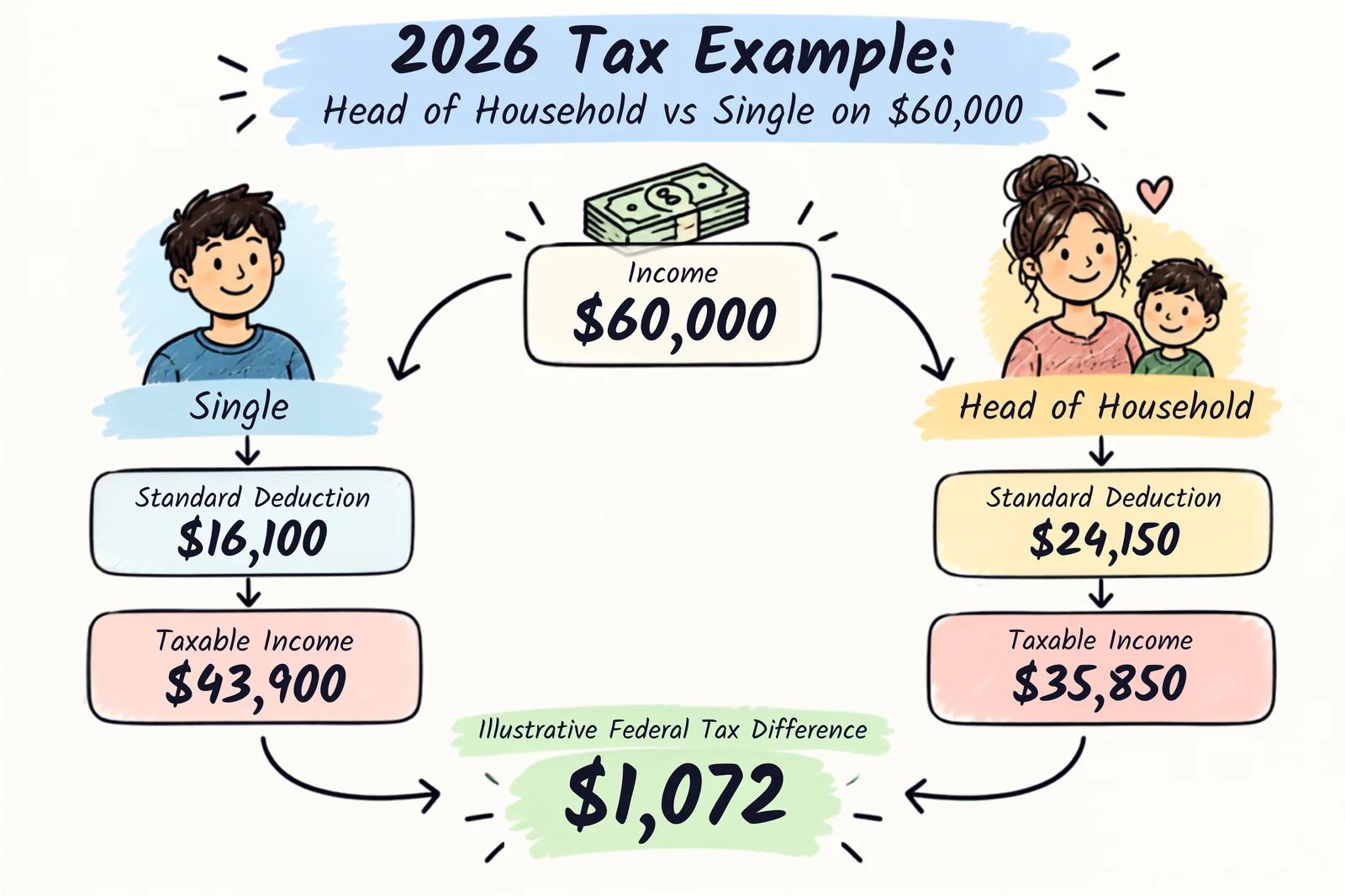
Suppose a taxpayer has $60,000 of income and uses the standard deduction, with no other deductions or credits included in this simplified illustration:
- Single Filing Calculation: $60,000 − $16,100 = $43,900 taxable income (≈ $5,020 federal tax liability).
- Head of Household Calculation: $60,000 − $24,150 = $35,850 taxable income (≈ $3,948 federal tax liability).
- Potential Difference: About $1,072 in potential federal tax savings.
This is only an example. It does not account for tax credits, itemized deductions, payroll taxes, other income, other deductions, state taxes or every individual tax circumstance. You can use our browser-based Budget Calculator to track your monthly take-home pay and net cash margin after tax withholding under IRS Publication 505 rules.
Head of Household vs Single: Which One Should You Choose?
You generally don’t choose whichever status gives you the lowest tax bill. You choose the filing status that accurately matches your circumstances.
If you qualify for Head of Household, it may provide a tax advantage over Single. If you don’t qualify, you should not use it merely because you support a family member, paid most of the rent, have a child, your ex doesn’t claim the child, or the tax calculation looks better. The eligibility rules come first.
Head of Household vs Married Filing Jointly
Head of Household is also different from Married Filing Jointly. For 2026, the standard deductions are:
- Head of Household: $24,150
- Married Filing Jointly: $32,200
But married taxpayers generally cannot simply choose Head of Household instead of filing jointly. A married person may qualify for Head of Household only if the specific requirements for being considered unmarried or other applicable rules are met. The IRS notes that many married couples save money by filing jointly, but the right choice depends on the household’s actual circumstances.
When Head of Household Is Not Better
Even if you qualify for Head of Household, don’t assume the filing status automatically produces the same result for every taxpayer. Your final tax outcome can depend on taxable income, tax credits, deductions, dependents, investment income, self-employment income, state taxes, and other circumstances.
The filing status is one part of the overall tax calculation. That’s why the right question isn’t: “Which status sounds better?” It’s: “Which filing status do I actually qualify for, and what does the complete tax calculation show?”
What About Median Household Income?
Median household income does not determine whether you qualify for Head of Household. Median household income is a statistical measure used to describe household earnings.
Head of Household is an IRS filing status based on specific eligibility requirements such as marital status, household costs and a qualifying person. Your income level can affect your overall tax calculation and eligibility for certain credits, but there is no general “median household income” threshold that determines Head of Household status.
Common Head of Household Mistakes
Avoid these common missteps when evaluating your tax filing status:
- Assuming having a child automatically qualifies you: A child must meet the applicable IRS requirements. Not every dependent automatically qualifies.
- Thinking the child must be claimed as a dependent: Certain custodial-parent situations can allow Head of Household even when the noncustodial parent claims the child.
- Counting every expense: Not every family expense counts. Excludes clothing, education, medical, vacations, transportation.
- Assuming two parents can both file HOH: Only one parent may claim the same child for this purpose in a shared-household situation.
- Assuming living apart from spouse automatically makes you HOH: The “considered unmarried” rules contain additional requirements beyond separation.
The Penny Flow Head of Household Check
Use this as a screening tool, not a substitute for the IRS rules:
- Marital status: Were you unmarried or considered unmarried on the last day of the tax year? Yes → Continue. No → Check the married-taxpayer rules.
- Home costs: Did you pay more than half the cost of keeping up the relevant home? Yes → Continue. No → You generally don’t qualify.
- Qualifying person: Do you have a qualifying child or other qualifying person under IRS rules? Yes → Continue. No → You generally don’t qualify.
- Special situation: If your situation involves divorce, shared custody, a noncustodial parent, a parent you support, an unmarried partner, multiple people in the same home, or a spouse who lived elsewhere, check the specific IRS rule rather than relying on the three-question screen alone.
Bottom line: If the three core tests point toward eligibility, Head of Household may be the correct filing status. If one fails, stop and investigate before filing.
Real Life Examples: Which Situation Looks Like Yours?
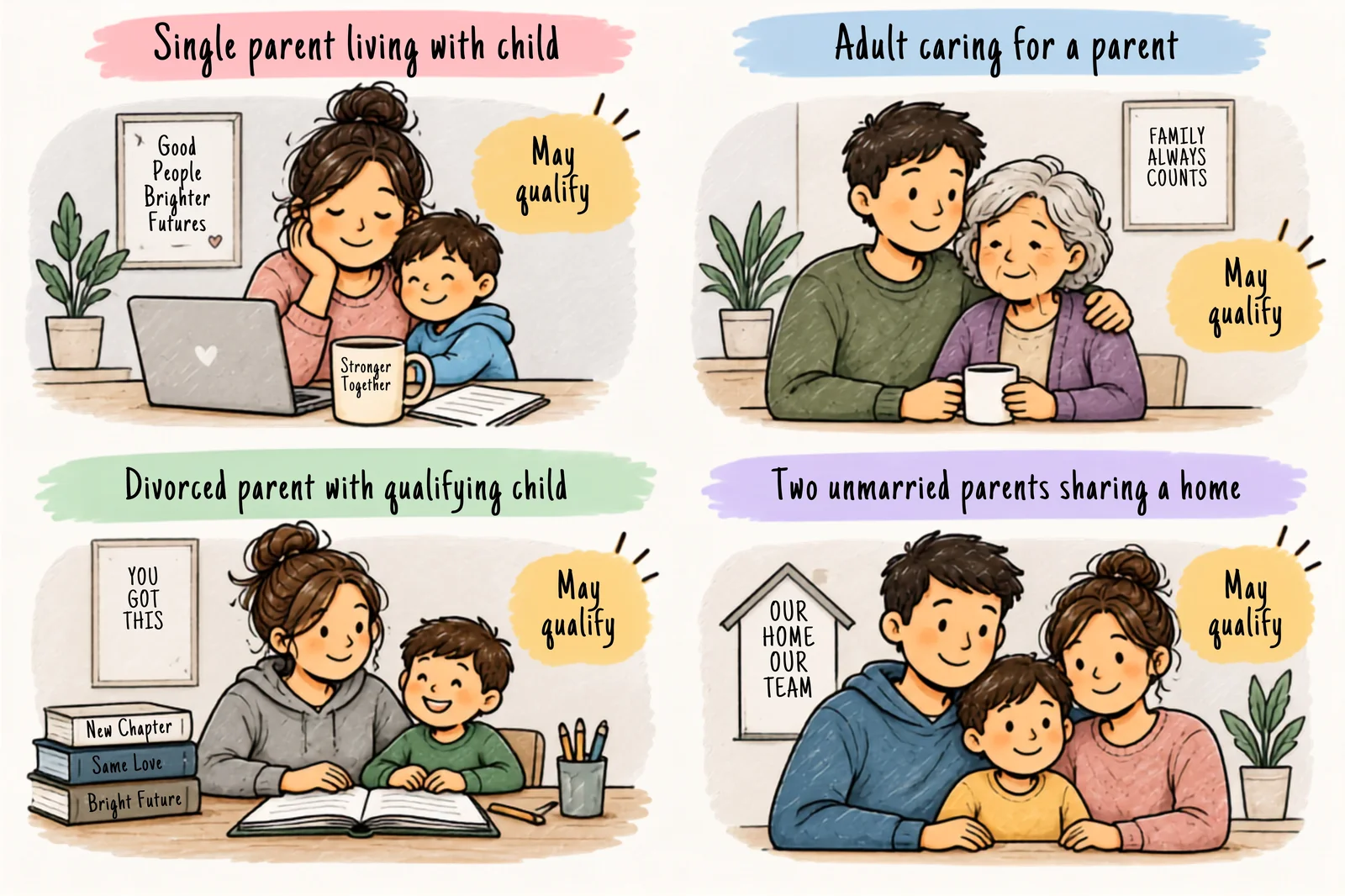
- Single Parent: You are unmarried, your qualifying child lives with you under the applicable rules, and you paid more than half the cost of keeping up your home. Potential result: Head of Household may apply.
- Divorced Parent: Your ex claims the child as a dependent, but the child lived with you and you paid more than half the cost of maintaining your home. Potential result: You may still qualify depending on the IRS rules.
- Adult Supporting a Parent: You are unmarried and support a qualifying parent. Your parent does not necessarily have to live with you if the special parent rules are satisfied. Potential result: Head of Household may apply.
- Married Taxpayer Living Apart: You are still legally married but your spouse did not live in your home during the last six months of the year. Potential result: You may qualify as considered unmarried if all the other requirements are satisfied.
Frequently Asked Questions (FAQ)
Q: Can I file Head of Household if I don’t have a child?
A: Yes, potentially. A qualifying person does not necessarily have to be your child. A qualifying parent can qualify under special IRS rules, among other circumstances.
Q: Can I file Head of Household if someone else claims my child?
A: Possibly. A custodial parent may still qualify in certain circumstances even when the noncustodial parent claims the child as a dependent.
Q: Can both parents file Head of Household?
A: Generally, not for the same child in the same household situation. IRS rules determine which parent can use the child as a qualifying person.
Q: Does my child have to live with me?
A: Generally, yes, for more than half the year, subject to IRS rules and exceptions. Temporary absences such as school can receive special treatment.
Q: Can I file Head of Household if my parent doesn’t live with me?
A: Possibly. The IRS has a special rule for a qualifying parent, provided the applicable dependency and household-cost requirements are met.
Q: Can I file Head of Household if I am married?
A: Possibly, but only under specific circumstances. A married taxpayer may be considered unmarried if the IRS requirements are satisfied.
Q: What expenses count toward keeping up a home?
A: The IRS generally includes rent, mortgage interest, property taxes, insurance, utilities, repairs and food eaten in the home. It excludes clothing, education, medical treatment, vacations and transportation.
Q: Is Head of Household always better than Single?
A: Not automatically. If you qualify, Head of Household can provide a higher standard deduction and different tax brackets, but your overall tax result depends on your complete financial situation.
Before You File: Check These 5 Things
- Your marital status on the last day of the tax year
- Who lived in your home and for how long
- What you personally paid toward maintaining the home
- Whether the person you’re relying on is a qualifying person
- Whether any special rule applies to your situation
Keep supporting records such as rent or mortgage documents, utility bills and other relevant household records. If your situation involves divorce, shared custody, a parent, or another unusual family arrangement, use the applicable IRS guidance rather than relying only on a general checklist.
Key Takeaways
- Head of Household and Single are different filing statuses.
- Head of Household generally requires you to be unmarried or considered unmarried.
- You generally must pay more than half the cost of keeping up your home.
- You also need a qualifying person under the applicable IRS rules.
- Having a child does not automatically make you Head of Household.
- A parent can sometimes qualify you even when the parent does not live with you.
- A custodial parent may sometimes qualify even when the other parent claims the child as a dependent.
- For 2026, the Head of Household standard deduction is $24,150, compared with $16,100 for Single.
- The correct filing status depends on your actual circumstances, not simply which option produces a lower tax bill.
Sources & Methodology
This article uses IRS guidance as the primary source for Head of Household eligibility, qualifying persons, household-maintenance costs, special rules and filing-status situations:
- IRS Filing Status Guide
- IRS Publication 501 (Dependents, Standard Deduction, and Filing Information)
- IRS Federal Income Tax Rates and Brackets
- IRS Guide: Filing Taxes After Divorce or Separation
- IRS Publication 505 (Tax Withholding and Estimated Tax)
Methodology: The Penny Flow uses official IRS rules as the primary authority, then organizes them into a decision-first framework with simplified examples and real-life scenarios. The tax examples provided are illustrative rather than personalized tax advice.
Final Takeaway
The difference between Head of Household vs Single isn’t simply about getting a bigger deduction. The first question is whether you qualify.
Start with three tests: Are you unmarried or considered unmarried? Did you pay more than half the cost of keeping up your home? Do you have a qualifying person under the IRS rules?
If the answer points toward Head of Household, then compare the actual tax consequences. If your situation involves divorce, shared custody, a parent, or another unusual household arrangement, go one step further and check the specific IRS rule that applies. For tax-year 2026, the difference can be meaningful, but eligibility comes before tax savings.
Disclaimer
This article is for general educational purposes and is not individualized tax, legal or financial advice. Federal tax rules can change, and individual circumstances can affect filing status and tax liability. For a situation involving divorce, custody, dependents, multiple households or other complex circumstances, consult the current IRS guidance or a qualified tax professional before filing. For complete details on our editorial governance, review our Editorial Policy, check our Privacy Policy, examine our Terms of Service, or Contact Us.
About the Author
Abdullah Riaz is a personal finance content creator and technical writer with 3+ years of experience helping readers understand tax planning, budgeting, and financial literacy. He holds a Bachelor of Science in Computer Science from HITEC University Taxila and brings both technical precision and accessibility to personal finance topics. His work has helped thousands of readers navigate tax filing requirements and optimize their financial planning. When he’s not writing, Abdullah creates educational content on tax strategy and personal finance on multiple platforms.
Note: This article reflects IRS guidance current as of September 2026. Tax rules can change. Always verify with current IRS publications or consult a tax professional for personalized advice.
Share Article
Financial Mouse Trap: Why Earning More Doesn’t Always Build Wealth