Financial Mouse Trap: Why Earning More Doesn’t Always Build Wealth
How the financial mouse trap catches high earners and the timeless principle to escape it.
When More Income Means Less Financial Freedom
Earning more money should make it easier to build wealth. But for many households, it does not.
A raise can disappear into a larger rent or mortgage payment. A better-paying job can bring higher transportation costs, bigger subscriptions, more eating out, or new monthly commitments. Unexpected economic pressure emerges, a family member needs financial help, or medical expenses arise. A credit card balance can turn yesterday’s purchase into tomorrow’s payment.
The result is a paradox: income rises, but financial freedom does not.
If you’re earning $70,000 to $150,000 a year and feel financially trapped anyway, this article is written for you. You do the ‘right’ things financially. You have a solid income, you pay your bills, you might even save a little. Yet your financial margin the money left after obligations keeps shrinking because of the financial mouse trap. Raises don’t create the breathing room you expected. Every extra dollar gets absorbed before you can decide what it should accomplish.
Feeling financially trapped does not necessarily mean you are bad with money. Economic pressure, fixed obligations, debt, and lifestyle increases can all reduce the margin available to build wealth.
What Is the Financial Mouse Trap?
The Penny Flow calls this pattern the financial mouse trap: a condition where more income keeps getting absorbed before enough of it can become lasting financial capital.
It is not a formal financial term. It is a Penny Flow metaphor for a cash flow pattern in which expenses, obligations, debt, and lifestyle increases keep catching new income before that income can create meaningful financial margin. The financial mouse trap is especially dangerous because it operates silently.
The way out of the financial mouse trap is not simply to earn more. The solution is creating enough financial margin that some of what you earn can stay with you, become capital, and eventually work toward your financial future.
Why does this financial mouse trap happen to high earners? Often, it’s not a lack of discipline it’s how the financial system operates. The financial mouse trap affects people across income levels, but it’s most visible among those earning solid middle to upper middle class incomes who should feel secure but don’t.
Economic Pressure: The Forces That Tighten the Financial Mouse Trap
The Federal Reserve’s 2025 household survey found that 58% of adults said changes in the prices they paid had made their financial situation worse. This economic pressure driven by Inflation, rising housing costs, healthcare expenses, and increasing living standards affects every household.
Economic pressure doesn’t always come from personal overspending. It comes from external forces:
- Rising housing costs that force landlords to increase rent
- Healthcare expenses and unexpected medical bills
- Rising education costs for children
- Inflation reducing purchasing power
- Job transitions requiring new expenses
- Economic uncertainty requiring emergency savings
A car repair can become a credit card balance. A medical expense can delay another bill. A period between jobs can force a household to use savings. Economic pressure forces many households into a financial mouse trap, requiring difficult trade-offs with every dollar.
Federal Tax Withholding: Why Your Salary Isn’t Your Take Home Pay
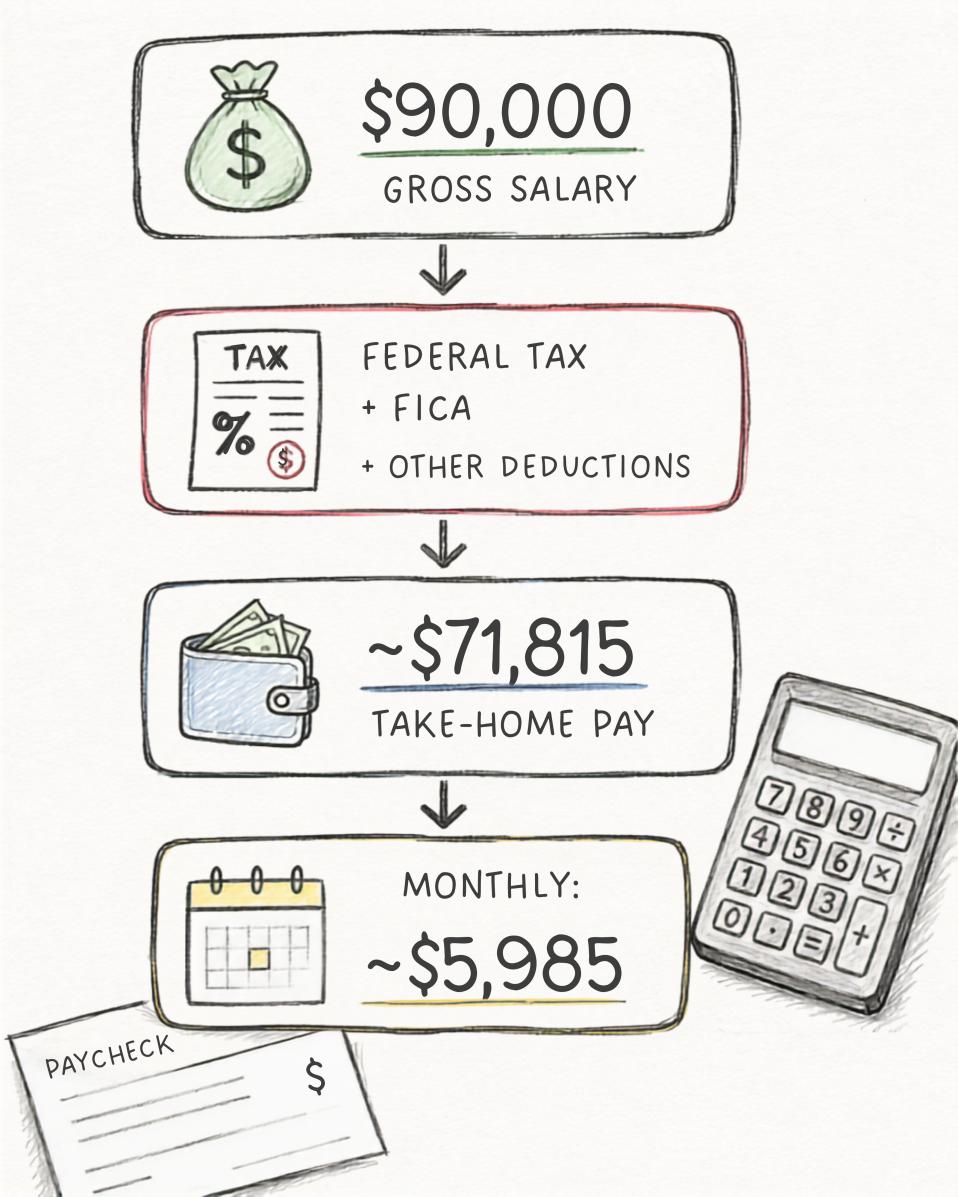
Many people focus on their gross salary, but that’s not the number that matters for escaping the financial mouse trap.
Suppose someone earns a hypothetical $90,000 a year. That $90,000 is not the amount that arrives in the checking account. Federal income tax withholding and other payroll deductions reduce the amount available for household spending and saving.
The IRS explains that federal income tax withholding is calculated using information reported on Form W-4, including filing status, multiple job adjustments, credits, other income, and deductions. The amount withheld from your paycheck depends on your individual tax situation, including the information reported on your Form W-4 and other payroll deductions.
The useful question for breaking out of the financial mouse trap is: After federal taxes, FICA deductions, and other withholding, how much money is actually available to run the household and build the future?
For illustration, consider a hypothetical $90,000 annual salary. The amount that reaches a person’s bank account will depend on their federal tax situation, payroll taxes, benefits, retirement contributions, and other deductions. The important number for household planning is the actual take-home pay shown on the paycheck not the gross salary.
The financial mouse trap gets stronger when every raise which seems substantial in gross terms is reduced by federal tax withholding and creates another commitment.
The Trap Gets Stronger: How Raises Become Lifestyle Inflation
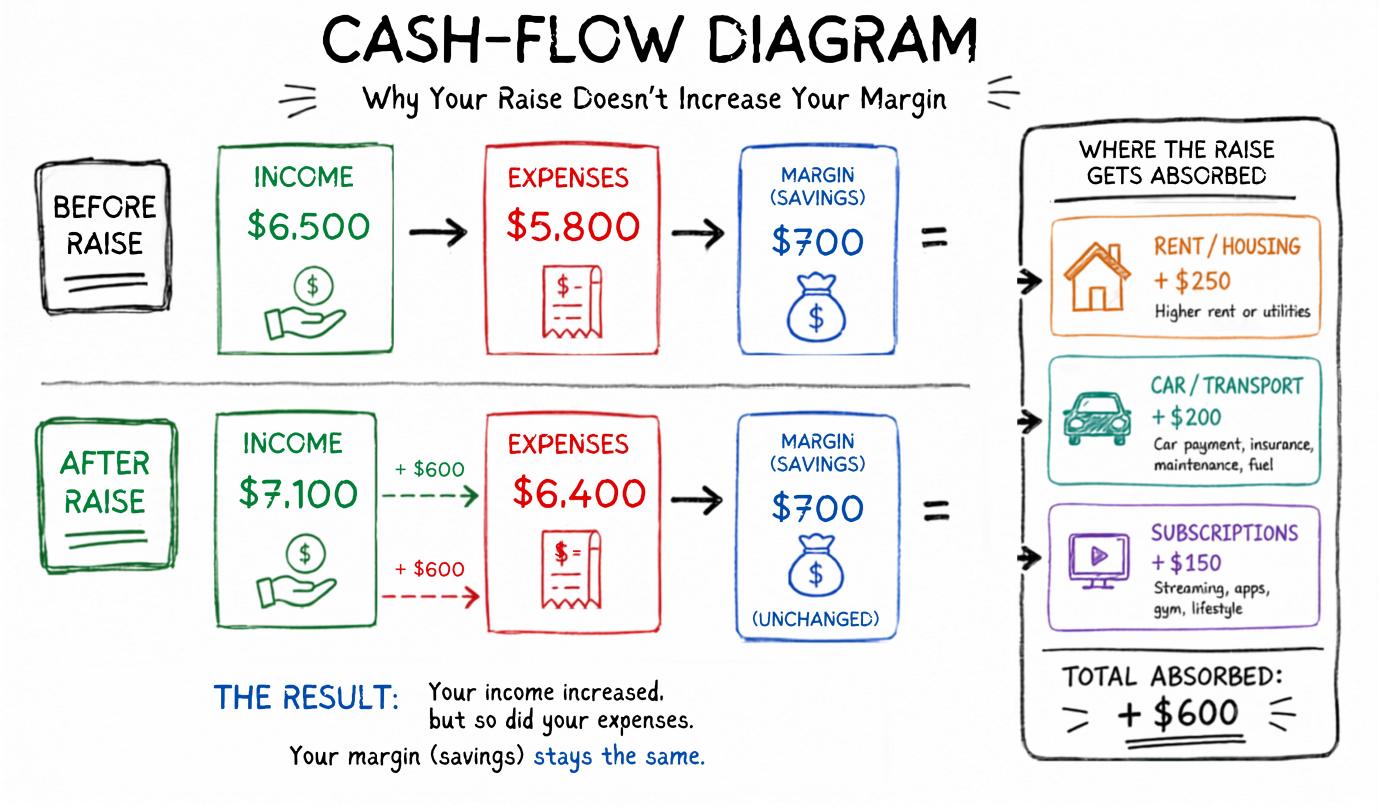
Consider a hypothetical household bringing home $6,500 a month after federal taxes and withholding.
Monthly cash flow:
- Essential living expenses: $3,400
- Debt payments: $700
- Family support: $500
- Lifestyle spending: $600
- Other recurring commitments: $600
Total expenses: $5,800
Financial margin remaining: $700
Now imagine the household receives a raise that increases take-home pay by $600 a meaningful boost. But what happens to that extra $600?
If new expenses immediately absorb it, a new car payment (+$400/month), increased rent (+$150/month), new subscriptions and lifestyle upgrades (+$50/month), the household still has roughly the same $700 of monthly financial margin.
Income increased. Financial margin did not.
This is the core insight of the financial mouse trap: a raise is an opportunity to increase financial margin, but it is not automatically an increase in financial margin. Without intentional choices, lifestyle inflation consumes the raise before it becomes capital.
A Hypothetical “Household”: When a $12,000 Raise Isn’t Enough
The following example is hypothetical and is designed to illustrate how recurring expenses lock high earners into a financial mouse trap.
Consider a hypothetical worker earning $95,000 a year as a marketing manager. After receiving a promotion to $107,000, the worker’s take home pay increases, but new recurring expenses absorb the additional cash flow.
For illustration, suppose the additional monthly take-home income is $900. The household then adds:
- Rent: +$350/month
- Car payment and transportation: +$400/month
- Work lunches: +$100/month
- Family support: +$200/month
- Subscriptions: +$50/month
Total new commitments: $1,100/month.
In this hypothetical example, the new recurring commitments exceed the additional $900 of monthly take home income by $200. The lesson is not that every raise produces this result. It is that lifestyle increases, recurring obligations, and family support can absorb an income increase, keeping you in a financial mouse trap.
This is the permission language you need to hear: It’s not your fault. The system is designed this way. Raises rarely create breathing room because lifestyle and obligations expand automatically alongside income. The problem isn’t that you’re bad with money. The problem is that every dollar is already assigned a job before you see it.
Family Support: When Financial Help Becomes Part of the Trap
Financial pressure and the financial mouse trap don’t always come from personal spending alone.
Sometimes money leaves the household because someone else needs help. That can mean:
- Helping parents with living expenses or healthcare costs
- Supporting adult children or younger siblings
- Contributing to housing costs for extended family
- Covering a family member’s emergency medical bill
- Assisting with an important bill during someone’s hardship
There is nothing inherently wrong with helping family. The problem begins when family financial support becomes so large or unpredictable that the household has no financial room left for its own emergencies and future goals.
If $500 leaves the household every month to support family whether parents, siblings, or adult children that $500 cannot simultaneously become:
- An emergency reserve for unexpected economic pressure
- A debt payment reducing interest costs
- An investment advisor’s recommended contribution toward wealth building
- Savings for your own family’s future
Family support can also become harder to manage when a household or its relatives face financial pressure. When a family member experiences hardship, a household may choose to provide additional support at the same time that its own expenses are rising. That combination can put additional pressure on monthly cash flow.
Debt: How Yesterday’s Spending Traps Tomorrow’s Income
Debt can make the financial mouse trap even tighter.
Imagine buying something today with a credit card and carrying the balance forward. The purchase happened in the past, but part of future income now has a job: paying for that past purchase.
This is how the financial mouse trap works with debt:
- You make a purchase on credit (past event)
- A balance accrues interest (present consequence)
- You make a required payment (future obligation)
- That payment reduces available cash flow (financial mouse trap tightens)
Many credit card issuers calculate interest daily using an average daily balance, although the exact method depends on the card agreement. If interest is accruing on a carried balance, paying down the balance can reduce the amount of interest that accrues over time, depending on the card’s terms and payment timing.
Past spending → debt balance → interest accrual → future payment → less future cash flow available
That last part is what matters most: Every required debt payment takes a portion of future income before you have a chance to decide what that money should accomplish.
A person can therefore earn a good income and still have little financial freedom if too much of tomorrow’s cash flow is already committed to yesterday’s purchases.
Beyond Salary: Investment and Real Wealth Building
Many people assume the solution to the financial mouse trap is finding a higher-paying job. But the principle behind the mouse trap reveals why earning more isn’t the answer if the trap is still functioning.
The real solution isn’t about earning more. It’s about understanding the flow of money and ensuring some of it reaches capital status before it gets absorbed.
As George S. Clason explained in The Richest Man in Babylon a timeless financial classic the path to wealth isn’t about income. It’s about ensuring a portion of what you earn stays with you. Clason’s “Seven Cures for a Lean Purse” focus on practical habits such as saving a portion of your earnings, controlling expenditures, making money multiply, protecting accumulated wealth, preparing for future needs, increasing your ability to earn, and improving your financial judgment and earning capacity.
The broader lesson for breaking out of the financial mouse trap is that earning more can help, but higher income alone does not build wealth if spending and obligations rise just as quickly. The primary lever is creating enough financial margin that a portion of what you earn can be retained, protected, and eventually put toward future goals.
Key Principle from The Richest Man in Babylon: “A part of all you earn is yours to keep.” This is not optional advice it’s the foundation of wealth building. If every dollar is immediately assigned to somebody else, some past purchase, or some new lifestyle commitment, there is nothing left to become capital.
First keep part of what you earn. Then decide what that money should accomplish.
From Financial Margin to Capital: The Essential Difference
Suppose the hypothetical household above has $700 left after its regular monthly commitments. That $700 is not automatically wealth. It is financial margin breathing room to escape the financial mouse trap.
What happens next determines whether the margin disappears or becomes capital:
- Some may need to remain available for short-term emergencies (emergency savings)
- Some may be used to reduce expensive debt (debt paydown)
- Some may strengthen an emergency reserve (building resilience)
- Some may eventually be considered for long-term investing (wealth building)
An important principle from investor.gov: Savings can be appropriate for short-term goals or emergency funds, while investing involves putting money into assets such as stocks or bonds with the expectation of a return over time. Different dollars have different jobs based on their timeline and purpose.
Give different dollars different jobs:
- Money needed within 6 months: Emergency reserve (safety)
- Money for 1-3 years: Debt reduction or goal savings (accessibility)
- Money for 5+ years: Potential investment vehicles (growth)
Investor.gov also emphasizes that compound growth works by earning returns on money invested as well as on the returns that money earns. Regular investing over a long period can give compounding more time to work. But there is a critical condition: there has to be financial margin available to invest consistently in the first place.
Financial margin comes before the investment account in this story. You cannot invest money you don’t have. You cannot escape the financial mouse trap by taking investment risk you escape it by first creating margin.
The Penny Flow “Financial Mouse Trap” Test: Identify Where You Are
Here is the framework The Penny Flow uses to identify whether the financial mouse trap has already formed in your household. Answer these questions honestly to see your own cash-flow reality.
1. How much take home income actually arrives? Start with the money available after federal income tax withholding, FICA deductions, and other deductions.
2. How much is already committed? List housing, utilities, transportation, insurance, food, debt payments, and other recurring obligations.
3. How much future income is already tied to debt? Look beyond the balance itself. Ask how much of next month’s income is already committed to payments and interest.
4. How much goes toward family support? Include regular and reasonably predictable support of parents, adult children, or other family members. Do not judge the decision. Measure its cash-flow impact.
5. What happens when income increases? When you receive a raise, bonus, or better-paying job, does your financial margin increase or do new expenses quickly absorb the additional income?
6. What remains at the end of the month? This is your current financial margin. If the answer is close to zero, the trap is already visible.
7. What job does the remaining money have? Is it building emergency savings, reducing expensive debt, funding a near-term goal, being invested for a long-term goal, or simply disappearing through unplanned spending?
8. How dependent are you on the next paycheck? A household with a high income but almost no available margin may be caught in a financial mouse trap and be more financially fragile than its income level suggests.

Do Not Escape One Financial Trap by Entering Another
Once someone realizes that cash flow is tight and they are caught in a financial mouse trap, the next temptation can be to chase higher returns through risky investments or aggressive strategies.
But this creates a different problem. Investing is not a guaranteed escape route. All investments involve risk, and appropriate risk depends on factors such as time horizon, your ability to tolerate losses, and your financial goals. Diversification can help manage risk, but it cannot guarantee that a portfolio will avoid losses.
That means the escape route should NOT be: “I need higher returns, so I should take bigger risks.”
Instead, the proper sequence to break out of the financial mouse trap is:
- Create margin (spend less than you earn)
- Protect important short-term needs (emergency fund)
- Deal with expensive debt (reduce interest drag)
- Identify long term money (money you won’t need for 5+ years)
- Invest according to the goal and risk you can accept
Chasing returns without first creating margin is like looking for a shortcut when you’re already lost. You’ll just get more lost.
The Real Escape Route: The Income to Capital Framework
The financial mouse trap is not solved by one budgeting trick. It is solved by changing what happens to the money after it reaches your household.
The complete journey from income to lasting wealth:
- Earn: creates income
- Keep: prevents all income from disappearing
- Control: keeps expenses from automatically expanding to absorb every raise
- Protect: creates emergency funds for unexpected economic pressure or events
- Reduce expensive debt: prevents interest from consuming future cash flow
- Build capital: turns financial margin into money with a future purpose
- Invest: gives suitable long-term money an opportunity to grow while accepting investment risk
- Own: moves the household toward productive assets rather than relying only on wages
- Increase earning ability: improves the potential size of the entire system
Notice that ‘increase earning ability’ comes at the end not at the beginning. You must first prove that you can keep some of what you earn. If you cannot, earning more will only create a bigger financial mouse trap.
Your One Next Step: Calculate Your Financial Escape Margin
Do not start by searching for the perfect investment. Do not try to time the market or find the highest-returning asset. Start with your actual cash flow to escape the financial mouse trap.
Financial Escape Margin = Take-home income − essential expenses − debt payments − family support − other recurring commitments − discretionary spending
So the calculation list becomes:
Take-home income: $__________
Essential expenses: $__________
Debt payments: $__________
Family support: $__________
Other recurring commitments: $__________
Discretionary spending: $__________
Financial escape margin: $__________
Interpreting your result:
- Negative number: You’re spending more than you earn. The first problem is the cash-flow gap itself this must be fixed before investing or escaping the financial mouse trap.
- Close to zero: You have very little protection against unexpected economic pressure, medical expenses, or family emergencies. The financial mouse trap is already tightening.
- Positive number: You have margin available to build with and escape the financial mouse trap. The question now becomes: What job will this money do?

What the calculator helps you do:
- Enter your take home income
- Organize monthly expenses across housing, living costs, financial obligations, lifestyle spending, and savings priorities
- See how your income is allocated across different spending categories
- Calculate the amount remaining after your listed expenses and savings priorities
- Use the results to understand your current monthly cash flow and escape the financial mouse trap
Use the Penny Flow Budget Calculator to map your current monthly cash flow and identify your financial margin.
Sources & References
- Federal Reserve — Report on the Economic Well-Being of U.S. Households in 2025 (May 2026)
- Internal Revenue Service — Topic No. 753, Form W-4, Employees Withholding Certificate
- Consumer Financial Protection Bureau — How does my credit card company calculate the amount of interest I owe?
- George S. Clason — The Richest Man in Babylon (1926). Seven Cures for a Lean Purse.
- U.S. Securities and Exchange Commission, Investor.gov — Introduction to Investing & Asset Allocation
About the Author
Abdullah Riaz writes practical personal finance content for The Penny Flow, focusing on everyday money decisions, budgeting, saving, investing, and building stronger household cash flow. When he’s not writing about financial systems, you can find him exploring how simple frameworks solve complex money problems like the financial mouse trap.
The Penny Flow specializes in content for middle to upper-middle income earners who feel financially trapped despite earning well and want practical frameworks to build financial freedom.
Financial Disclaimer
This article is for general educational and informational purposes only. It is not personalized financial, investment, tax, or legal advice. This content reflects U.S. financial systems, tax rules, and banking practices and is not applicable to other jurisdictions.
Tax rules, household circumstances, interest rates, and investment returns can change. All investments involve risk, including the loss of principal. The past performance of any investment is not a guarantee of future results.
Consider your own circumstances and, when appropriate, consult a qualified financial advisor, tax professional, or attorney before making significant financial decisions regarding tax planning, debt management, investment allocation, or other financial matters.
The information presented about the Federal Reserve, IRS, CFPB, and SEC is current as of September 2026 and based on publicly available sources.
The Penny Flow and its author assume no liability for any financial decisions made based on this content.
Share Article
Other Articles